

Targeting and Goal Setting: Why Accessible Potential Matters
Targeting and goal setting are closely related, yet most pharmaceutical companies treat them as separate activities.
Traditionally, territories and target lists are built using prescription volume. Companies identify high-volume prescribers, often in Deciles 6-10, and create territories around them. This approach works well if a product has broad formulary coverage, no access restrictions, and little competition. In reality, however, most products face formulary barriers, prior authorization requirements, generic competition, or stronger managed care positioning from competitors.
As a result, prescription volume alone often overstates true market opportunity.
The Problem with Traditional Targeting
Many biopharma companies attempt to improve targeting by excluding generic prescriptions or removing Medicare and Medicaid volume before performing deciling and territory design.
While this is an improvement, it still assumes that all remaining prescriptions represent equal opportunity. They do not.
A high-volume prescriber may appear attractive on paper, but much of that volume may be inaccessible because of formulary restrictions or strong competitive advantages.
From Raw Potential to Accessible Potential
The Marketing Advantage addresses this issue by converting Raw Potential into Accessible Potential. This adjustment is made in two steps:
Adjust for Product Substitutability
Not all competitive prescriptions represent the same opportunity.
Consider the soft drink market. Coca-Cola is highly substitutable with Pepsi, somewhat substitutable with Dr. Pepper, and far less substitutable with ginger ale. While all are beverages, consumers do not view them equally.
The same principle applies in pharmaceutical markets.
Conclusion

Some therapies are direct therapeutic alternatives, while others are only partially interchangeable due to differences in indications, efficacy profiles, patient populations, administration methods, or clinical guidelines.
TMA evaluates the degree to which competing products are substitutable for our brand and adjusts competitive prescription volume accordingly. Scripts written for highly substitutable products contribute more to opportunity than scripts written for products that represent weak alternatives.
Adjust for Managed Care Status
The second adjustment considers managed care realities.
For each competitive prescription, we evaluate and compare the formulary status of the prescribed product to our product within every patient’s health plan. If patients belong to plans where our product is not covered, those opportunities may effectively be inaccessible. Likewise, if our product faces significant formulary disadvantages, the likelihood of conversion may be substantially lower and the potential is lowered.
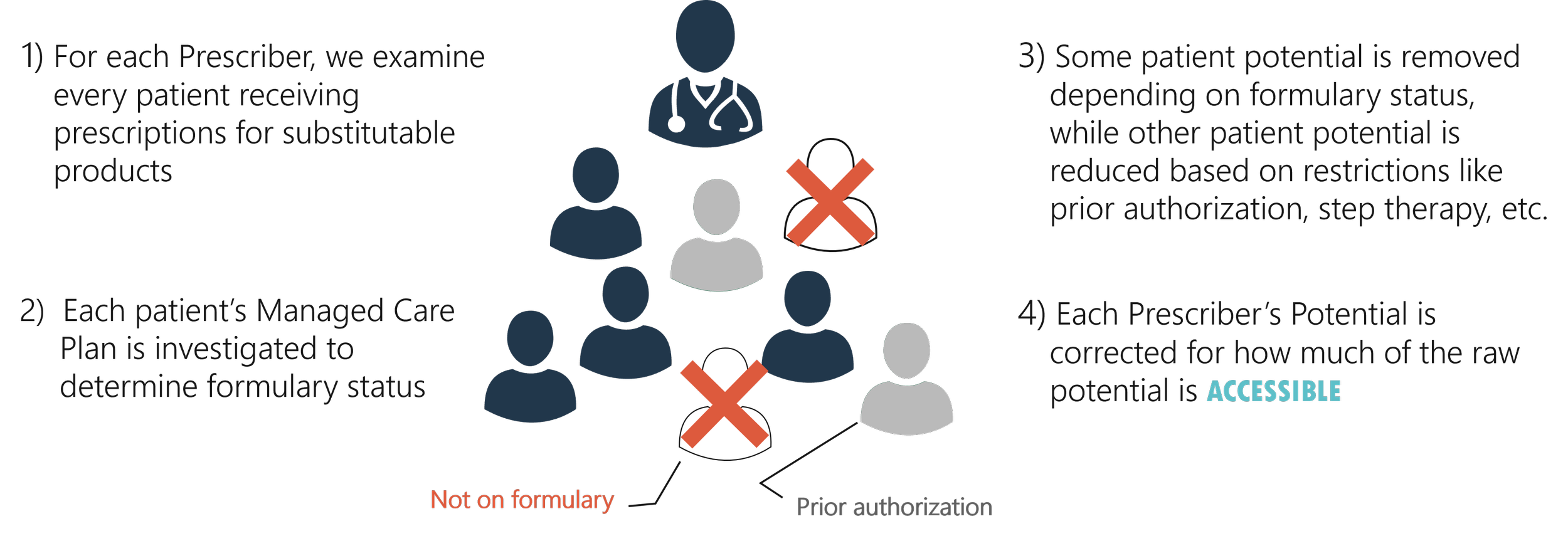
TMA therefore adjusts opportunity at the patient level based on the relative formulary position of our product versus the currently prescribed therapy. The result is a more realistic assessment of market potential.
Better Targeting, Better Alignment
The difference between Raw Potential and Accessible Potential can be substantial.
Consider a territory with several prescribers that appear highly attractive based on Raw Potential alone. Many organizations target these prescribers because they are assumed to represent the greatest opportunity. In reality, those assumptions are often inaccurate. In Figure 1, the size of each circle represents a prescriber's Raw Potential. However, when Accessible Potential is evaluated instead, the relative attractiveness of these prescribers changes significantly, revealing opportunities that Raw Potential alone can obscure.
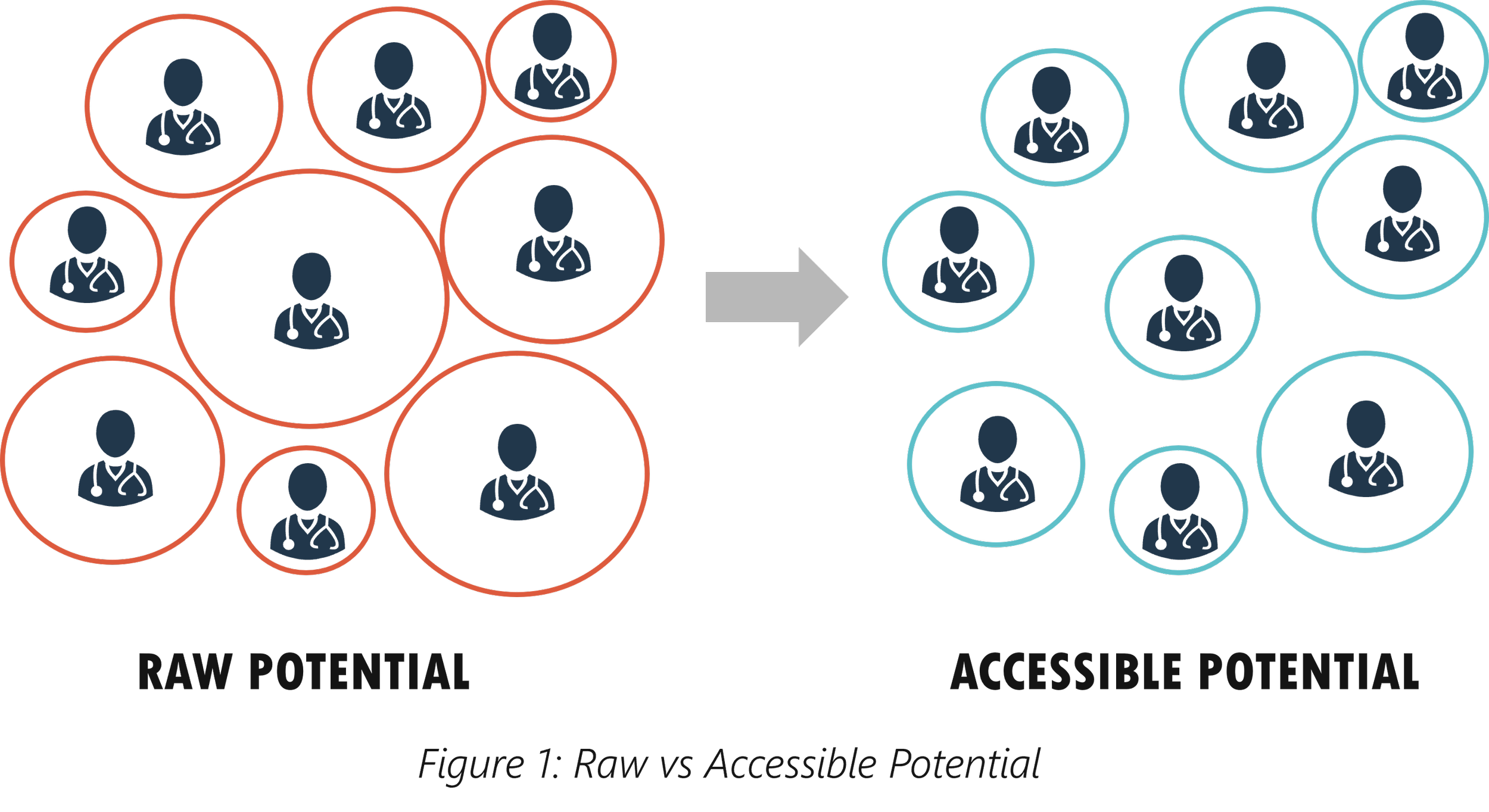
Organizations that rely solely on prescription volume or raw potential risk overestimating opportunity in some territories. More importantly, they may focus their resources on prescribers with limited likelihood of conversion, while overlooking those with greater accessible opportunity. By incorporating Accessible Potential into targeting decisions, companies can improve resource allocation, prioritize the right prescribers, and create a more accurate view of market opportunity.
Prescription volume alone is no longer sufficient for territory alignment, targeting, and goal setting. Managed care access, formulary position, and competitive substitutability all influence a product's true opportunity.
By focusing on Accessible Potential, pharmaceutical companies can align resources around realistic market opportunity rather than theoretical volume.
In Part II, we will show how Accessible Potential can dramatically improve goal setting and create more equitable performance expectations across the sales force.